About
the iAM.AMR project
Executive Summary
Antimicrobial resistance (AMR) refers to the ability of microorganisms, such as bacteria, fungi, or viruses, to withstand (or partially withstand) the effects of an antimicrobial to which they were formerly susceptible. Infections caused by antimicrobial-resistant microorganisms are more difficult to treat than those caused by their susceptible counterparts; antimicrobial resistance increases the risk of serious health outcomes and the economic burdens associated with illness.
One source of antimicrobial-resistant microorganisms is the agri-food system; a nexus of human, animal, and microbial interaction. The goal of the iAM.AMR project is to use an integrated assessment modelling approach to better understand the effects of factors (e.g., exposures, practices, interventions, and occurrences) in the agri-food system on the occurrence and prevalence of antimicrobial resistance that affects human, animal, and environmental health (collectively, One Health).
Integrated assessment modelling is a scientific modelling approach designed to facilitate decision-making by linking domains of large, highly complex systems – like the agri-food system – together through shared measures. Essentially, Integrated Assessment Models (IAMs) allow stakeholders and decision-makers to ‘pull levers’ and explore the effects of changes in one domain on another.
In short, we:
- conducted structured literature reviews to identify factors associated with the occurrence of antimicrobial resistance,
- extracted data, and entered it into a publicly accessible database, CEDAR,
- defined an integrated assessment modelling framework (iAM.AMR) to connect these factors,
- queried CEDAR to build iAM.AMR models, and,
- examined scenarios to identify sets of interventions that may reduce human exposure to antimicrobial resistance determinants.
Learn More
History and Funding
The drivers of antimicrobial resistance in the Canadian agri-food system are complex and interconnected. Figure 1, produced by Majowicz and colleagues (2018), demonstrates this complexity.
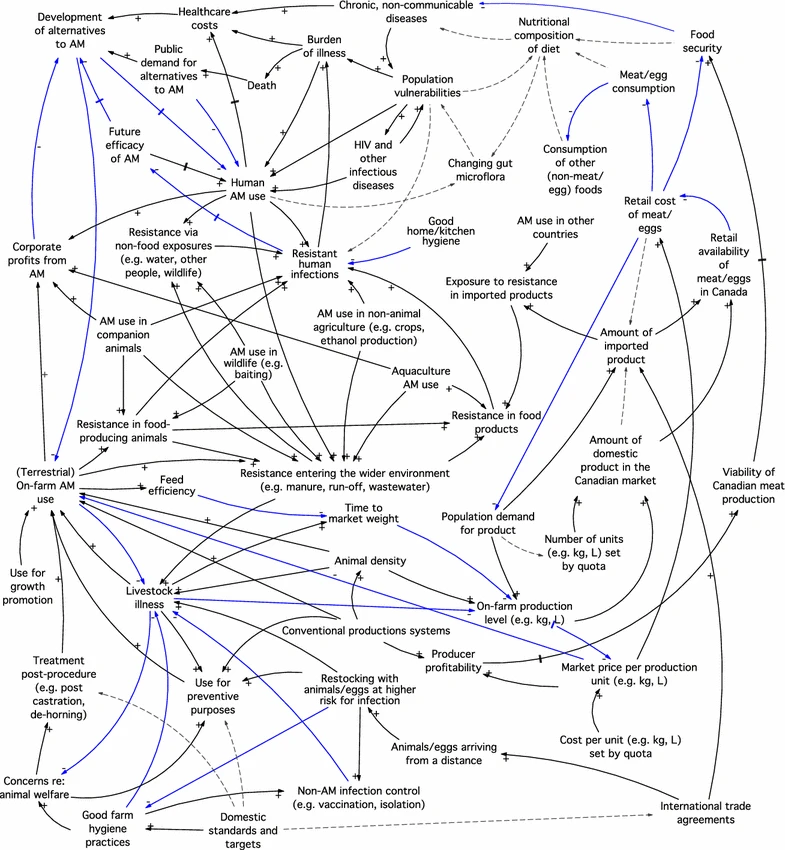
The iAM.AMR project began with the goal of quantifying the relative impacts of these drivers – among other factors – on the occurrence of antimicrobial resistance affecting human health.
- In 2014, the iAM.AMR project was funded by the Ontario Ministry of Agriculture, Food and Rural Affairs’ (OMAFRA’s) New Directions Funding Program (Project ND2013‐1967), with a focus on Ontario, Canada.
- In 2016, the iAM.AMR project became part of Canada’s Genomics Research and Development Initiative (GRDI) AMR project (2016 - 2022) and expanded focus to all of Canada.
- In 2022, the iAM.AMR project continued as part of the GRDI AMR - One Health (OH) project (2022 - 2027).
Learn more about the GRDI-AMR and GRDI-AMR-OH projects at the unofficial website.
GRDI-AMR (2016 – 2022)
A $11.1 million project across five federal departments and agencies to support the development of genomic resources used to understand and combat AMR in the agri-food system.
GRDI-AMR-OH (2022 – 2027)
A $9.8 million project across six federal departments and agencies to build upon the successes of the GRDI-AMR project and further address AMR using a One Health approach.